
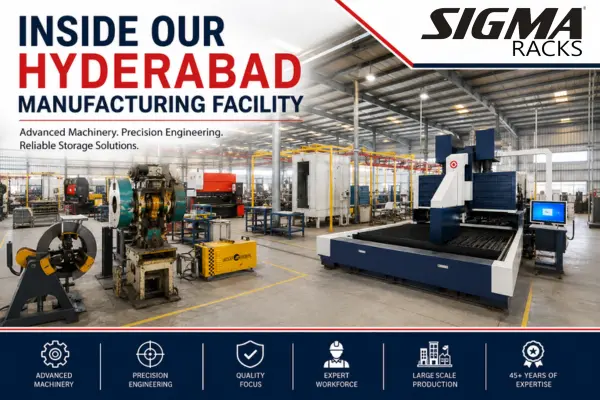
How precision engineering, an integrated production line, and process discipline at our Kandlakoya, Hyderabad plant turn raw steel coil into the retail fixtures trusted by leading global sportswear and lifestyle brands — and the industrial components trusted by OEM clients.
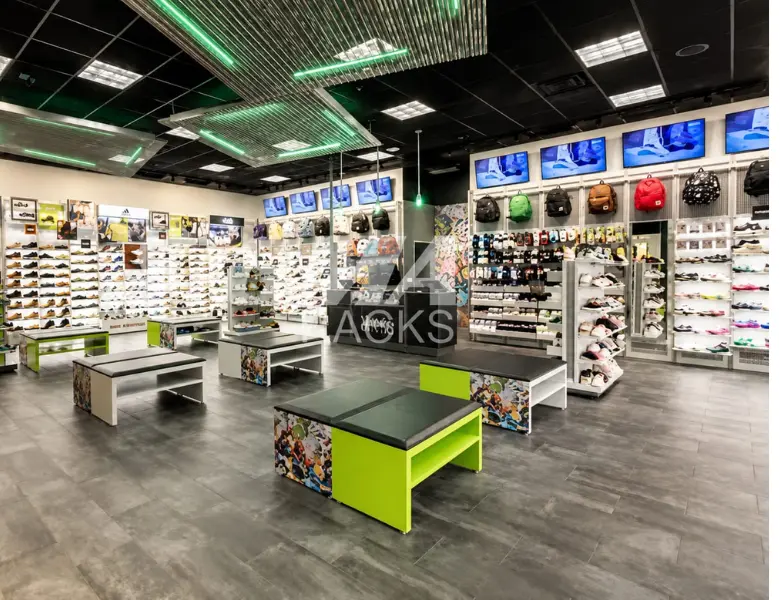
A retail fixture looks simple once it's installed: a clean wall, an even shelf, a bracket that lines up the same way every time. What's invisible is everything that had to go right before it got there — the steel cut to the same tolerance on the thousandth piece as on the first, every weld inspected, every bend landing within a fraction of a degree of the drawing. That invisible discipline is what our Hyderabad facility, in Kandlakoya, is built around.
What began as a sheet metal fabrication unit has grown into one of South India's most advanced retail fixture and footwear rack manufacturing facilities — one that industrial and OEM clients also trust for precision sheet metal components. The plant runs a fully integrated production line spanning coil processing, laser cutting, CNC and panel bending, pressing, welding, and finishing, so a part or fixture never has to leave the building between raw material and a powder-coated, installation-ready product.

Quality Philosophy
Quality Isn't a Department. It's the Process.
The easiest way to build an unreliable fixture is to make quality something that happens at the end — a final inspection that catches problems after the steel, the labor, and the time are already spent. We build it the other way around: quality checks live at every station, not just the last one.
Raw coil is checked against specification before it's slit or cut. Cut parts are dimensionally verified before they move to forming. Bends are checked against the drawing before a batch runs to completion. Welds are inspected for penetration and finish before a part goes to the paint line. By the time a component or fixture reaches powder coating, it has already passed through several checkpoints — not one.
That discipline is backed by a documented plant process flow with clear ownership at every stage, a structured preventive-maintenance schedule for critical machines like our laser cutting and forming equipment, and operators trained specifically on the machine they run. The result is consistency: the fixture we ship on order five hundred looks and fits exactly like the one we shipped on order one.
Our commitment to quality extends beyond the shop floor. We are actively working toward formal quality certification as part of a broader push to serve export and OEM markets with fully documented, auditable manufacturing processes.
The Production Line
From Raw Coil to Finished Fixture, Under One Roof
Every station on our floor feeds the next. That's what separates a purpose-built manufacturing line from a job-work shed with a few machines bolted together — less handling between steps, tighter tolerances carried through the whole process, and a finish that's consistent from the first piece to the thousandth. Here's how a part moves through the plant.
1. Coil Processing
Every job starts with raw steel coil, decoiled and slit to the exact width the job calls for. Getting this stage right matters more than it looks — an inconsistent slit width compounds into misalignment three or four stations later. Our slitting and decoiling lines feed cut-to-size, consistent-gauge stock straight into the cutting stage, with no manual resizing in between.
2. Laser Cutting
This is where precision actually begins. Our laser cutting bay runs STPL and Bodor 3kW fiber laser cutting systems for flat sheet, plus a dedicated HSG pipe-cutting machine for tube and profile work. Fiber lasers cut with a narrow kerf and a clean, largely dross-free edge — which means tighter dimensional accuracy on every part and far less secondary deburring before a piece moves to forming or welding.
That precision compounds downstream. A laser-cut panel that's true to the drawing means a bend that lands exactly where it should, a weld joint that closes with minimal gap, and a finished fixture that assembles the same way every time — without on-the-floor "adjustment" to make parts fit. For OEM and industrial clients, this is the stage where tight tolerance and repeatability get built in, not inspected later.
3. Panel Bending
For complex, multi-bend parts — enclosures, cabinets, and fixture components with more than one fold — we run a fully automatic CNC panel bender (referred to in our machine list as the B2 bending machine). Unlike a conventional press brake, which forms one bend at a time and requires the operator to reposition the part between folds, a panel bender clamps the sheet once and folds it through a full, CNC-programmed sequence in a single setup.
That matters for two reasons. First, surface finish: the panel bender folds the sheet from beneath using a forming blade rather than striking it with a punch from above, which keeps the visible face of the part scratch- and mark-free — important for retail fixtures and enclosures where the finished surface is what the customer sees. Second, repeatability: because the entire bend sequence is programmed rather than manually re-set between folds, complex multi-bend geometries come out identical, part after part, without the cumulative positioning error that can creep in when a part is handled and re-clamped multiple times on a standard brake.
4. CNC Press Brake Bending
Alongside the panel bender, our CNC press brake handles heavier-gauge material and larger-format folds where a traditional brake is the right tool for the job — precise, programmable bending across a wide range of thicknesses and part sizes.
5. Precision Pressing
For high-volume component runs, our press shop covers the full range — 20, 30, 50, and 100 ton power presses — so tonnage is matched to the part rather than forced through a single machine. That range is what keeps forming consistent whether the job is a light bracket or a heavier structural component, without over- or under-stressing the material.
6. Welding & Finishing
Joining is handled across 14 MIG welding stations, 2 TIG stations, and dedicated ARC, laser, and stud welding setups — matched to the material and joint type rather than run through a single process. Every weld is followed by grinding (21 stations, plus 2 dedicated KPT grinding machines) to bring the joint flush and clean before the part moves to our in-house powder coating line, so the finish that leaves the building is the same finish that was specified on the drawing — no exceptions made at the last station to hit a ship date.
Six process stages. One accountable team. A part that starts as raw coil on Monday can be a powder-coated, inspected, installation-ready fixture by the end of the week — without a single handoff to an outside vendor.
Precision Manufacturing
Precision Components: Where It Matters Most
Retail fixtures forgive a little. A bracket that's half a millimetre off still holds a shoe. Industrial and OEM components don't get that forgiveness — a part that's out of tolerance doesn't assemble, doesn't fit its mating part, and comes back. That's the standard we hold every precision component to, whether it's headed to a retail fixture or an OEM client's production line.
Precision isn't one machine or one inspection step. It's carried through the whole process: a laser-cut blank that's true to the drawing, a bend that lands on the programmed angle because the panel bender or press brake never had to reposition the part mid-sequence, a press that's tonnage-matched to the material so it doesn't over- or under-form, and a weld that's ground flush before it ever reaches finishing. Every one of those stages either holds the tolerance or breaks it — there's no "close enough" step in between where an error can hide.
Material consistency matters just as much as machine accuracy. Steel coil is tracked by batch, so the gauge and grade a part is cut from on day one of a production run is the same as day ten — which matters for structural components where variation in material thickness changes how a part performs under load, not just how it looks. And because cutting, forming, pressing, welding, and finishing all happen on the same floor, a dimensional issue gets caught and corrected at the next station, not discovered after the part has already shipped.
Dimensional accuracy — parts are checked against the engineering drawing at cutting, at forming, and again before finishing, not just at final inspection.
Material consistency — coil is tracked by batch so gauge and grade stay consistent across an entire production run, not just the first piece.
Repeatable finish — every weld is ground flush before it reaches our in-house powder coating line, and every coat is matched to the specified colour, texture, and coverage.
Complex geometries, one setup — CNC panel bending folds multi-bend parts in a single clamped sequence, removing the positioning error that creeps in when a part is repositioned bend by bend.
Scale without compromise — tonnage-matched pressing from 20 to 100 tons keeps forming consistent whether the part is a light bracket or a heavier structural component.
Order-to-order consistency — a repeat order is checked against the same drawing and the same process as the first run, so part 5,000 fits exactly like part 1.
This is what lets us take on the two ends of the same job at once: a component that has to meet an OEM client's drawing to the letter, and a retail fixture that has to look flawless on a shop floor under direct lighting. Both are precision work. We just apply the same discipline to both.
Precision in Every Detail
What the Finish Looks Like Up Close
Specifications and process descriptions only go so far — precision is easiest to see in the details that would show a mistake immediately: a mitred corner that isn't square, a punched hole pattern that drifts out of line, a folded edge with a visible seam. These are close-up, unedited shots straight from our production floor and our export component range, showing the corner joinery, perforation, edge finish, and hardware fit that every part is held to before it ships.
Specialization
Two Things We Do Better Than Most
Precision sheet metal components. We manufacture to the tight tolerances and finish standards that industrial and OEM clients demand. That's a direct result of the process described above — laser-true cutting, single-setup panel bending, tonnage-matched pressing, and inspection built into every stage — not a claim we make after the fact. Parts come out repeatable, inspected, and on-spec, run after run.
Footwear & retail display racks. We design, fabricate, and finish the display walls, shelving systems, and footwear racks that leading sportswear and lifestyle retailers put on their shop floors — including installed fixtures across multiple premium brand store zones. Concept, fabrication, and finish, all handled in-house, by the same team and the same quality process used for our precision component work.
Proof, Not Just Claims
See It In Stores
These are our fixtures, installed and in daily use — men's, women's, and kids' zones, across multiple leading footwear and lifestyle brands. Every wall below is the same laser-cut, panel-bent, welded, and powder-coated process described above, delivered as a finished retail environment.
Multi-brand wall serving three lifestyle and footwear brands on one fixture run.Lifestyle wall serving three footwear and comfort brands on one fixture run.Sportswear brand wall, close detail of the shelving system.
Fresh Off the Floor
Our Newest Store Fit-Out
This is one of our most recent installations, photographed on opening day — every wall, feature table, and lighting element built and installed by our team, from the same Kandlakoya process described above.
Multi-brand wall with a freestanding feature table in the foreground.Lifestyle brand wall — full-height shelving with integrated lightboxes.
One Roof, One Team, Zero Handoffs
From raw coil to installed fixture — coil processing, laser cutting, panel bending, press brake forming, precision pressing, welding, and finishing all happen at our Kandlakoya facility, with one team accountable at every step. Whether it's precision components for an OEM line or a full retail fixture rollout, this is the plant — and the process — that builds it